Breaking Point

I love snow.

I have this outdoor plant from Luzern (everything from Luzern is superior, including cheese, Emmi products, and Catholics).

I love snow. But, it’s snowing. A lot.

The leaves look weak and the plant looks weighed down by the snow. Twice a day, I go outside and get rid of the snow, trying to give the plant some support.

It needs some support. It’s too much snow.

Snow is lovely, but it’s heavy. When flakes come together, they have weight and power. One snowflake? No problem. But pile snowflake on top of snowflake, and you get something. Something heavy. Something that can snap a 100-year old tree in half. One melting snowflake can start an avalanche.

When does a plant or a tree (or a person) reach a breaking point? When does the avalanche happen? When is one tiny snowflake or nasty email or person’s rejection…too much?

I saw avalanches when I walked down the Col du Grand Saint Bernard. There is no warning. Something snaps and that is it. “Breaking Point,” in this case, seems like a post-mortem diagnosis.

The snow is falling in Uitikon. Snowflakes are building. Only one thing to do…photo

When it feels like too much; it is. Get rid of it. Whatever “it” is. Stay away from your breaking point.

Back Injury in Switzerland – Part Two: Personal Trainer – Lorraine Jenkins – English speaking

(This is part of a 3-post series regarding a back and neck injury I had in Switzerland from 2014-2015. I have been asked by many people how I got “better” so quickly and miraculously. I hope my information is helpful.)

Lorraine works at Booster Pilates with the Lagree Fitness Method (http://www.lagreefitness.com/about/) and has a great deal of expertise in physical fitness, overall health, and nutrition. She speaks English (from the UK), Italian, and a bit of German.

Today, we joke about my first day in May of 2014 with Lorraine. My shoulders were completely caved in, I looked like a turtle. I had major balance problems because there was no core anymore, no real center of gravity – only mental fear and physical pain in my neck and back. But, I could walk and that’s what she worked with. My legs were strong…and that was it.

Lorraine is an excellent diagnostician. She knows the body so well. Lorraine’s trinity is that she intrinsically knows how much is too much, how much is reparative, and how much is therapeutic. Finding a trainer who will quickly discern what keeps you plateaued on days when your body is aching (especially during the first few months of physical therapy), what gets you loose on days when your muscles are tight, and what builds your strength and endurance. That’s her special recipe and here are specific examples of how she does it, using Lagree terminology.

The Catfish- This is an exercise that Lorraine used to build my confidence. She told me from the second week, “you’re The Catfish Queen.” This has variations and the “normal” version is all we did for three months. Why? Because I simply could not handle more and she knew it. The first time we tried the 2nd variation, she said, “this will be easy for The Catfish Queen” and it was.

The Wheelbarrow- Lorraine almost always starts with this and reminds me to feel in my abs. But, I couldn’t at first. I felt it in my back because I didn’t really have “an ab.” I could only do it for about 30 seconds. I think she used The Wheelbarrow as a litmus test to know, each workout, how my body was doing that day. It is the best way to start a Lagree workout (in my opinion) because of that reason. If something is off, somewhere in the body, you know it when you do The Wheelbarrow.

Plank to Pike- Both of us felt it the day I did this. This is a freaking tough thing to do. In March, I was told I would probably be in a wheelchair by June. One morning in October, Lorraine and I attempted The Plank to Pike. It’s December now and we do 4 of the 5 variations. Truly a miracle.

Lorraine Jenkins “Lo-J”. Wherever she is in Switzerland, find her. Lorraine has the patience of a saint. Twice, I came into the studio crying and I cried during the entire workout. Once, I was so frustrated with myself, I screamed (I never scream) at her. As I said, there is something inherent in her that just “gets” it. The woman works with pregnant women, injured women, other Pilates instructors, anyone. She “gets” it.

Back Injury in Switzerland – Part One: Physical Therapist – Caroline Wolfsberger – English-speaking

(This is part of a 3-post series regarding a back and neck injury I had in Switzerland from 2014-2015. I have been asked by many people how I got “better” so quickly and miraculously. I hope my information is helpful.)

It was crucial in the early days to locate a good physical therapist, which is referred to as “physio” here. I found Caroline Wolfsberger by happenstance (www.theiss-training.ch/Profil.html). She is the first part of the Trinity that I believe saved me from a wheelchair.

From our first meeting, I knew she was committed to getting me to a place of wellness. I remember very clearly she kept using the word “we.” She never said “you” when she spoke of what needed to be done for me in the upcoming months. This was a key part of what allowed me to have hope.

Caroline is not an “average” physical therapist. Naturally, her primary focus involves therapeutic strengthening of the muscles and joints; however, she utilizes not only traditional Western methods (ie: what we imagine when we say “physical therapy”), but also alternative practices like cupping, pressure points, etc. Early on, Caroline used kinesiologic tape placed on my back in the shape of an “X” to pull my shoulders back.

In her words, “the treatment I am specialized in is Brügger-Therapie. He was a Swiss doctor, a genius actually! And I combine this with lots of other treatments: osteopathy, manual therapy, fascia technic, etc.” Caroline studied motivational psychology and focuses on treating the person – not only the body. “I am helping the people to help themselves by improving their Körpergefühl,” she adds. As she notes, there is no translation for this word. It’s more than a physical feeling; it’s a body-mind-spirit feeling.

As you have read, she is unique. She is at the top of her field professionally. She is the only physical therapist in this country I would trust.

I have already recommended her to many people with my strongest possible praise.

Apples and faith

How very Swiss the sermon was on Christmas eve/day. “Brothers and sisters in Christ, faith is like an apple.”

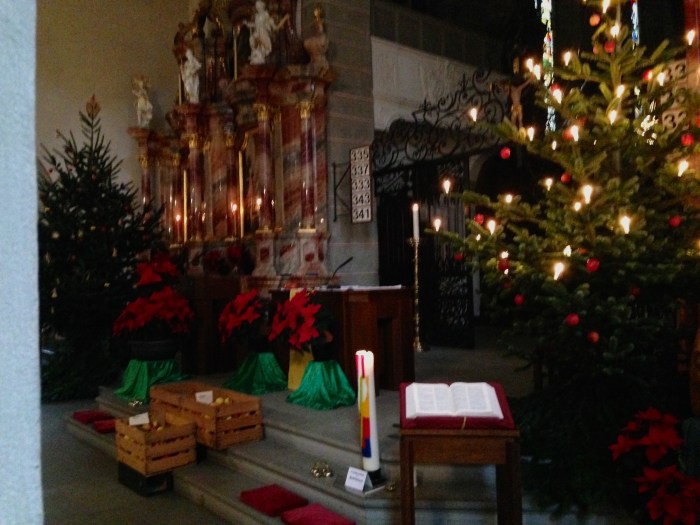
Father Luzzatto’s sermon was powerful, as is usually the case when someone stands at the pulpit at Franziskanerkirche. Apples and candles adorned our Christmas trees in my loving, liberal, Luzern church.

Ah, the apple. We love our apples here: raw, cinnamon-dusted, on a train, in a car, while walking. We love apples. There are well over 7,000 varieties of apples. Some are sweet and others are almost sour.  Certain “perfect” apples appear absolutely blemish-less, whilst others are picked from a tree and might have not only bruises, but possibly a plump worm hiding within. Apples used to be a sign of wealth. Countries have their own national favorites. It’s easily one of the top 3 most consumed fruits. Even Switzerland’s hero Wilhelm Tell was linked with the apple, which demonstrated his bravery, accuracy, and resilience under pressure (three rather important universal strengths).

But, the apple’s also an apt metaphor for faith.

There’s a small layer of a “shell” protecting it as it grows, matures, and thrives. Once past the fragile, but firm, exterior, one reaches the sought-after flesh. Interestingly enough, the true legacy each apple holds is far from that which is immediately seen or tasted. Buried underneath the peel, past the yummy inside, there it is: the core. We say, “das Kernhaus eines Apfels” in German. The core of each apple has the potential to bring literal life.

Even the proportions are similar. The outer layer is thin, but sturdy. The inner flesh definitely contains the majority of what makes an apple have its well-known taste. The core is similar to the outer layer because it is limited in size (and circumference, by nature).

There we have our proportions (those of us who are faith seekers). Our “faith” or outer armor is not so thick, but it is substantial. The inner stuff makes us who we are. The core (a purity of heart I believe we are all born with) is small, but drives everything from birth to death and then the next step…if it is protected.

Today I did a bit of research. There is a group in Asia trying to create an apple without a peel. Why? Because people don’t like the taste of the peel. “It’s bitter,” they say, “I just want the inside part.” There are hundreds of products created to help us get rid of our apple peel, including one of my favorite products, which is apple juice. We wish it was easier to get directly to and enjoy the delicious flavors of the apple. Who cares about that pesky peel layer, I want the good stuff!

Hell, we all do.

News Flash: the good stuff isn’t in the flesh – it’s in the peel. In particular, that area just between the peel and the flesh. You get a healthy dose of potassium, Vitamins A, C, & K, fiber, not to mention possible cancer-fighting elements and antioxidants. Eat only the flesh? You don’t.

It’s trendy now to eliminate that “armor.” But, when we eliminate the armor of “faith,” we lose a lot.  Not everything, we still get a delicious, wonderful, beautiful apple. But, picture an apple without a peel. How that would really be? It would be exposed to every storm, susceptible to every pest. The peel, the armor – they protect the flesh. Both the outer layer and the inner layer do something extremely important. They both protect the core. The inner layer cannot do it alone, that’s why the outer layer is crucial. Get it?

I struggle to imagine myself with the armor that has protected me. The armor I choose willingly and happily to wear fully aware of what makes it my faith and my armor. No one told me, “put this on just because.” No. I made the decision. Certainly, it would have been a lovely life without some of the doubts and anger that come with wearing the “armor.” The many times I felt my strong faith did not protect me or the ones I loved…or even the ones I saw who needed protection.

The church services on Christmas eve and day ended with everyone taking home an apple for him or herself. I am still thinking about this comparison and loving it more and more. Before we left, Father Luzzatto joked about our favorite apple.

Mine is definitely the Pink Lady apple. I loved them when I lived in Manhattan (my grocer carried them). They are a bit tart, but mainly sweet. The peel is tough, rugged.

Apples and faith. Such a beautiful pairing.

Amen.

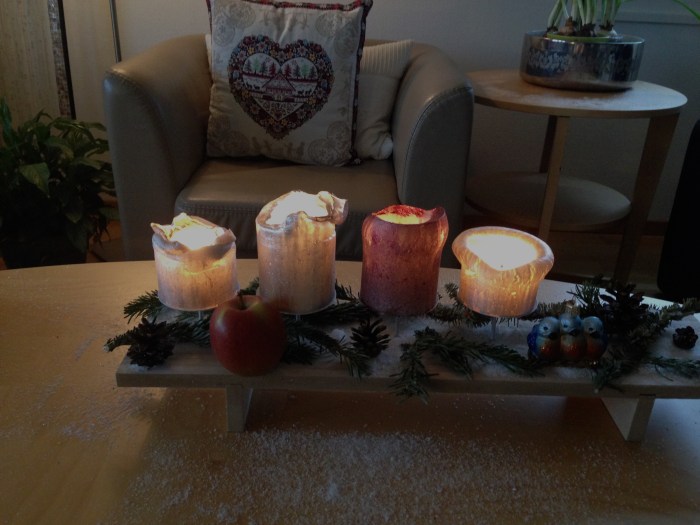
.Apples and ChristmasApple and Advent candles
 

Allerheiligen & Allerseelen – All Saints and All Souls day

“In honor of the saints – known and unknown.”

Rarely does a person reach his or her 21st birthday without experiencing the death of a (be)loved one. So, we all have common ground there.

How we express our loss is such a private choice. It seems to me, having seen people that did not express their loss and watching that downward spiral, the only important part of “how” is “that we do it.”

There are many solutions in the diverse forms: memorial service, Requiem, Shiva, Día de los Muertos, Janazah prayer, mourning flags, black clothing, white clothing, covered mirrors. Buddhists believe both how deeply and how long we mourn can be based on the “tie with the person.” I love that.

There is a difference between the sister holidays of All Saints and All Souls day. Traditionally, All Saints day was meant to honor those who died and were assured of eternal salvation. All Souls day was meant to honor those who were unbaptized and thus…well…destination unknown. This is the 2-part version of what some celebrate as a 3-day observance called “All Hallowtide.”

Being the devout Catholic I am, I can say clearly: I don’t like it. It’s a very man-made distinction and I don’t like those. I prefer to view things the way I’d hope our ever-loving God would. Do I imagine God making such a distinction?

No.

Allerheiligen is a big deal in Switzerland. Truly. The cemeteries and church are packed. The heads are not all grey, white, bald, or salt/pepper – there are younger people in both spaces. The presence of all ages reinforces what we’ve all learned consciously or subconsciously by age 21…

this life is temporary

 One way I’ve learned to express loss is beautiful. My church in Luzern makes Easter candles. Somewhere along the line, someone told me he burned his Easter candle the week before Allerheiligen and put it on the grave of his mother (it wasn’t L).Easter Candle on Allerheiligen

(This is what I do every year. It is how I have chosen to express loss.)

Candles cover the graves on Allerheiligen. As the sun begins to set, the people put candles on the graves of people they love and remember. I, too, have been honored to decorate the grave of a beloved member of my extended Luzern family (http://wp.me/p2dSt7-hA). I am at her grave often and I notice other people in mourning. I’ve noticed this expression of loss comes without as many tears being dropped on the graves we keep in memorium. Allerheiligen comes without quite as much pain.

It doesn’t always have to be painful, does it? Remember our loved ones can serve to renew the bond we had with them, instead of tearing open healed wounds.

Next year, on the 1st of November, remember your loved ones. If you are not near them, find a simple tree, light a few candles, say prayers/sing a song/read a poem. That’s what All Saints and All Souls day really mean.

We did not forget you, we remember your time here among us, and we honor you.

All Saints day

Why I am in love with SBB, CFF, and FFS (which does not stand for “for f***’s sake”)

Literally, the only relationship I have had for the past few years that never disappoints me is my relationship with the public transportation system in Switzerland.

Not kidding. It is a love affair. I am truly in love and it will never go away. Okay, maybe we will fight? I hope not. If we fought and I won, I would like to have the tilting train removed from my trips to the Romandie. If we fought and I lost, I would  agree to sit in the kids’ wagon for a month and babysit.

Here’s are 3 things I noticed on Sunday.

The train station in Zurich is AMAZING. They renovated it. Same in Geneva. This is only a good thing. It brings more businesses into the train station, which gives the majority of shop owners a break on Sundays (train stations are open, but 99.999999% of stores are not). It makes the train stations a place of commerce, instead of a place to (sorry) take a potty break. Sometimes on the ground (I’m looking at you, Grand Central Station where I saw a man go number 2!!).

Luzern recently redirected traffic leading into its train station. One lane is reserved for buses, taxis, etc. That is making major traffic for the cars in other lane. Hey, guess what? Don’t take your car. Take the bus or, gasp, WALK. Luzern, win-win from y’all! And, they’re renovating their train station, too. Amazing.

The last thing is crucial. The people employed by SBB (for the most part and I mean EVERYONE I’ve encountered and I take/arrange public transportation more than most) speak multiple languages, attempt to be friendly, and willingly engage in conversation with customers. There is a premium on customer service with SBB/CFF/FFS and the regional service providers.  That’s not so common these days. Non-natives like me appreciate knowing more about the best route from Bubikon to Wankdorf (not joking). It’s nice to chat about this with Beat, who comes from Riffelberg, speaks about 20 languages, and can tell me everything about the route, including how many dairy cows I will see. Bravo employees of the public transportation system in Switzerland. Seriously.

Look, I am someone without tons of money. I still invest in my yearly SBB pass (called a “GA” say it outloud and laugh, please. It’s a general pass for all the trains, trams, buses, ships, donkeys, elephants, etc. http://www.sbb.ch/en/travelcards-and-tickets/railpasses/ga.html). Why? Because They make my life infinitely easier and more pleasant. Traveling by train, even in the Kinderwagon, is civilized (for God’s sake, you can drink! ON THE TRAIN!), easy, dependable, and keeps another car off the road.

I’m in love. It’s funny because my “first train” ride in Zurich was my move. The train came from Munich. It was a horrible storm (this is not a joke) and the train hit a fallen tree, derailed, and we had to walk to the nearest bus, in the rain. The journey usually takes about 3 hours, I think. It took me 10 hours to get to Zurich.

But, it was a DB. Not SBB. 😉

I love you, SBB. I just wish I could tweet my love. Fix your Tweeter feed!!

(PS- Can you please talk to ZVV and have them make my train orange again? It goes better with my book. Thanks.)

The Pilgrim and the Politician

A man begins a pilgrimage to Rome in Canterbury, England, and eventually arrives at the Hospice of Grand St. Bernard. As he walks, he carries 88 years of joy, sorrow, and a rather large backpack on his back.

Traveling from Bern to the Hospice of Grand St. Bernard is another man, who is also on a journey. As he makes his way, he carries the arrival of a new baby and the weight of his country’s future on his back.

Pilgrims walk for different reasons. Our pilgrim walked, but he did not know why. He only knew he was called to walk and was uninterested in “why.” Politicians attend events for a myriad of reasons. Our politician attended an event in late June because he knew he should be there. He didn’t pay much attention to “why.” Both men were answering a call.

Nationality separated them. Language separated them. Normal, everyday differences separated them.

Why did Brian walk? Why did Christophe attend that concert?

Perhaps one of the many reasons Brian walked and Christophe attended that concert could be this blog post and the mere fact that you are reading it.

It’s 2014 and we can be jaded and cynical. Most of us see politicians as untouchable and most of us do not pay any attention to pilgrims. A politician would never waste his time talking to a pilgrim and they certainly would not be at the same event because politicians go to fancy places and pilgrims do not.

Wrong.

There are still places in this world that transcend language, nationality, age, religious beliefs, socio-economic differences. There are still places that bring people together for a common purpose, known or yet unknown. There are still places where two men from completely different walks of life can be brought together to share things – ideas, music, Raclette. There are places where the sting of cynicism is made weak.

We have to treasure these places and nourish them. We must feed them with our time, with our resources, and with our very best intentions. We have to look at these places as true sanctuaries because that is what they are.

They are places where the shoes on your feet do not matter. They are places where the color of your hair, your skin, your coat…none of it matters. They are places where a pilgrim and a politician are both seen as exactly what they are:  God’s children – truly equal and worthy of unconditional love and acceptance.

We must give our best to these places and the people walking into them. Both are deserving of our adoration.

I could say many things about the pilgrim and the politician. They are two of the finest men I have met in a very long time. It is not the point. The point is much simpler than that.

There is a place on the border between Switzerland and Italy where a pilgrim and a politician sat together and shared an important life moment.

That place is the Hospice of Grand St. Bernard.

You should go there and give it your best. If you cannot go there, you can still give it your best.

Donate 5 dollars, 10 Euro, 20 CHF, or 100,000£. What is your best? Give that.

Hospice du Gd-St-Bernard – 1946 Bourg-St-Pierre – Suisse
Union de Banque Suisse – 1920 Martigny
IBAN        CH50 0026 4264 6946 8001 X
BIC          UBSWCHZH80A

If we don’t give these places our best, how can this happen?

The Pilgrim and the Politician


As much truth as I can speak: “The kind of foreigner we want”

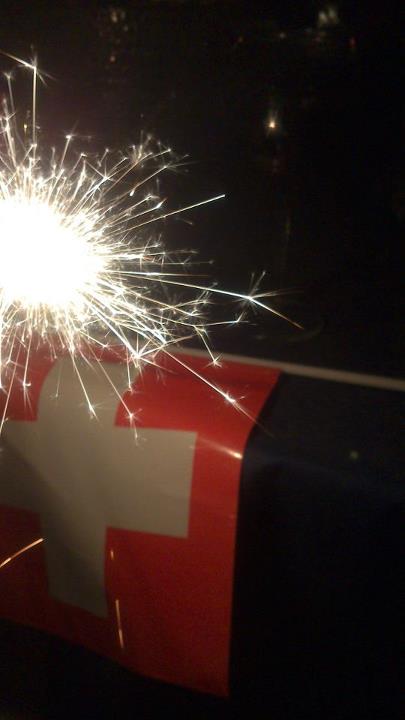
On August 1st, Swiss Independence day, I was privileged and honored to stand in front of a crowd gathered in the Valais at the foot of the Petit Mont Mort. I sang “Amazing Grace” and the words echoed in the shiny brown rocks that, just 16 months earlier, propelled my feet to the top of that mountain as it glistened with snow.

After a speech by the Mayor, I took the microphone again. I’d requested to sing the Swiss National anthem just as I’d done for 4 years in a row in my German-speaking home base of Luzern. José (God, bless him because I truly love this precious man) encouraged me to sing the first verse in my go-to German, even though the Valais is in the French-speaking part of Switzerland. I began singing the song I truly love for the people I truly love: the Swiss.

Trittst in Morgenrot daher – seh’ ich dich im Strahlenmeer... Schweizerpsalm

As the “Texas friend of the Hospice” sang their country’s anthem, I knew what at least a handful were thinking.

“She’s the kind of foreigner we want.”

Oddly enough, I am more old school “Swiss” than most of my Swiss friends. I believe in mandatory dialect language in the first 3 grades of primary school (I also believe in optional evening classes in dialect language once a week for parents). I believe in strict rules – clean up after yourself & others, don’t be too loud anywhere, continuing the tradition of mandatory military service, explore pragmatic options before resorting to extreme ones, go along/get along, greet people with “Bonjour”/”Grüezi”/etc., keep shops closed on Sunday, treat the elderly with respect, fresh air cures almost anything, let men fix the fondue. I want foreigners to reach B-level communication of their canton’s language in order to apply for a work/residency permit to make their lives here better/easier. I think people who flush their toilets after 10PM should get a ticket.

Oh! and I believe everyone should have the Swiss National anthem memorized. It’s too beautiful not to hold in your heart.

I’m still not the kind of foreigner they want.

As these beautiful faces from the Valais looked up at me and held me as an example, I was saddened and my voice cracked with emotion. I recorded it and I won’t play it. Not ever. It is the saddest thing I’ve ever heard. This country I love, admire, respect, nurture, protect, treasure, and adore…these beautiful men and women here and all over this country…

I am the foreigner they don’t want.

Even me.

Especially me.

The end of the first verse is so beautiful and I was touched when they unexpectedly joined in on this part…

When the Alps glow brightly, pray, free Swiss, in the name of your pious ancestors’ souls, pray to the God that dwells in our noble country.

After my time in the Valais, Sunday found me back at my beloved church in Luzern and the sermon was peculiar to a lot of them.

It wasn’t to me. I knew what he was saying.

“The disciples were afraid of her. She was foreign. She wore clothes they did not recognize. She spoke a language they did not know. She seemed desperate. They told Jesus not to pay attention to her. Jesus did not listen. He tested her faith, he saw she was a believer, he healed her daughter. It is our duty to have faith in humanity and to do so without judgment. It is human nature to be afraid of that which is foreign and we must fight this nature because it is inhumane.”

There is a joke in Texas that anyone not born in Texas is “foreign.” It’s a bit tongue-in-cheek because it’s meant to be funny, but also a bit ostracizing.

I’ll never joke about it again. It’s horrible to be labeled “foreign” by people you just wish would love you.

August 1, 2008August 1, 2008 – my first time celebrating Swiss Independence day

1st of August in 2009August 1, 2009 – Interlaken

August 1, 2010August 1, 2010 – Luzern

August 1, 2011August 1, 2011 – Luzern

August 1, 2012August 1, 2012 – Uitikon Waldegg

August 1, 2013August 1, 2013 – Uitikon Waldegg

August 1, 2014August 1, 2014 – The Hospice of Grand St. Bernard

Meeting Jean-Marie Lovey in his “home”

It was 2013 and I was a newbie at the Hospice of Grand St. Bernard. It was a difficult hike up the mountain and my body was suffering the next day.

I very vividly remember the next day, sneaking into the Crypt for some silence and seeing a Canon sitting in a nook playing a bit of music. He glanced in my direction, smiled warmly, and said something in French (probably the same thing I now say if I want to sing something while others around around…“Does my music disturb you?”). I didn’t know what he was saying, I just smiled. He continued.

His music was lovely.

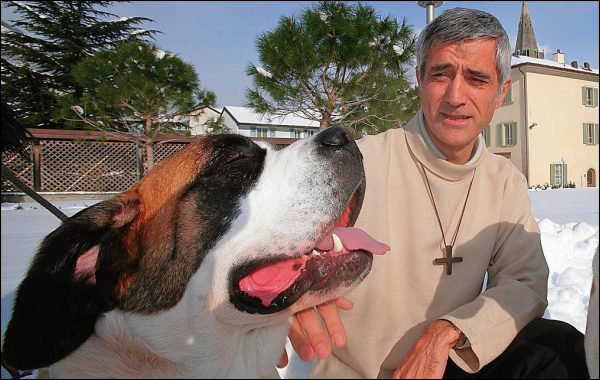
He is lovely. And, fittingly, he is Jean-Marie Love(l)y. Monsignor Lovey was the Provost of the Hospice of Grand St. Bernard. He is not quite a big as the beloved St. Bernard dogs, but he is every bit as friendly, warm, and loving.

On the 8th of July, Monsignor Lovey was announced as the next Bishop of Sion.

I think his own words about the Hospice, written for the brochure for the Hospice’s massive renovation campaign (and translated into English by me), say more about him than I would be able to:


Welcome to the place between Heaven and Earth


The birth of the Hospice in the 11th century was thanks to the work of Bernard of Menthon, the Archdeacon of Aosta. The Augustine Canons were charged with the task of protecting travelers, and the Hospice became a haven.


Bernard knew the Hospice of Grand St. Bernard at this high summit could reach people in the depths of their hearts. Since it began, our guests not only receive food, drink, a place to sleep, a roof over their heads; but also, prayer. Bernard’s work is still relevant today; time has not changed our purpose. We take those in need into our home on the mountaintop and shower them with the blessings of God to prepare them for their continuing journey.


For centuries, the Canons have worked to accommodate the daily needs of the Hospice. They have restored, rebuilt, expanded, and maintained. The Hospice is open year-round now, providing this house between Heaven and Earth as a steadfast reflection of its bold founder. The Congregation of Grand St. Bernard exercises its mission through extraordinary grace. This is God’s house. This is your house.


And you are always welcome.


Monseigneur Jean-Marie Lovey,


Canon and Provost of the Congregation of Grand St. Bernard


May God continue to bless Jean-Marie in his service as the Bishop of Sion.

And may God bless our beloved Hospice of Grand St. Bernard, José, Raphi, Jean-Michel, Anne-Marie, Frédéric, Anne-Laure, and all who walk through the door in service.


Jean-Marie Lovey

Lost in translation? I don’t think so.

I remember the day very clearly (it’s in my book). About four years ago, I was standing in front of someone and trying desperately to communicate in German – my 6th language.

“Ich weiss mein Deutsch ist nicht so gut,” I said.

“Ja und nicht gut genug.”

I know my German is not so good….to which he responded, “yes and not good enough.”

I refrained from saying, “Oh really? How’s your English? Tell me your thoughts on the Oxford comma? Passé?”

Today, I was dealing with a Swisscom employee. I am already a day behind because of Swisscom and also 400CHF poorer. This to say nothing of the pounding headache I have had since purchasing their product that would make my life “einfacher.” #itdidnt

Go on a little “with me” trip, as I call it. Especially those of you who get frustrated by non-native English speakers.

Picture yourself as a technical idiot trying to explain, in your sixth language, something said to you the night before on the Swisscom hotline by an actual technical expert. Imagine while this is happening, you are watching the minutes slowly tick toward the departure of your train.

Then, imagine the manager telling you in Swiss dialect “kein Englisch nur Tüütsch” (no English, only German), even though English is one of the working languages for Swisscom. Next, imagine missing both trains and still there is no solution from the people who sold you the mountain & the gold for 400CHF. You there? Great.

Now, add on to it that you, like everyone else in the world, have your own issues to deal with.

Really. Imagine all that.

It’s more than a headache. It’s the problem, in a global sense, with customer service and general apathy toward others – in particular, those who are foreign to us in some way.

Again, I’m not Mother Teresa (read the post entitled “I’m not Mother Teresa,” you’ll see), but when I see someone is struggling, for any reason, I go where they are. I can attempt other languages (including Latin and sign language) if I have to. Why? Because it’s not about me. It’s about the other person needing the help I can give.

I really don’t care if we are talking about a 5G connection cockpit username upgrade or directions to the bathroom or even spiritual discernment. Egal (I know that one…it means, “it’s all the same” like “equal” but super-sized). I am going to try my damnedest to be there and to help.

If I were in Texas and someone walked up to me (as a customer or a mere human) in need of my help and said, “passt Deutsch?” I would never say, “huh uh.” See, that’s the Texas (dialect) version of English (official language). Why would I do that? I have no need to make another person feel small, stupid, or subordinate. I would say “natürlich passt das, wie kann ich helfen?”

One of my favorite quotes, “Be the change you wish to see in the world.” We should all make sure we commit that one to memory.

In every language.