Bärli,
One opera refuses to leave me alone: Orfeo ed Euridice, written by Christoph Gluck.
Precious boy, even if you become the wisest, best-informed classical music historian/critic/snob of your generation, look down upon the Vienna version of this opera with disdain to the utter heartbreak of your mother. Nozze was my money maker, but Orfeo was my love.
The story of Orfeo and Euridice is one of almost unspeakable fidelity, suffering, and a love that knows no way to truly express what “love” is. So, let’s just put that little opinion to the side and stick a Cupid’s arrow/pin in it.
If a singer can fall in love with music by arriving through Hell? Mommy did. My first Orfeo ed Euridice, I arrived off-book and ready to go. With the Paris edition. Nope. “Vienna edition,” announced, clear as day, at the Sitz. So, I struggled. I’d learned a hard lesson earlier (in grad school) about being unprepared and I’d vowed never again. Before any rehearsal, I arrived knowing every vocal part, every orchestral part, down to the damn breath mark for the fifth flute (I’m exaggerating because I’m getting back into soprano mode). I was panicked.
Somehow, the terror of learning the new version added something to my Euridice that made her, I don’t know, untethered? unsettled? Feeling less than. Feeling like I didn’t fit. Feeling like I didn’t know how to take the steps necessary, sing the notes, play the part. I didn’t belong in that “Vienna” world, I belonged in the Paris edition. That’s the one I knew. But, I clawed my way through. Damn if my Orfeo, a dramatic soprano masquerading as “Amore,” and my side romance that summer didn’t pull me through. The three of them, my musketeers.
Boom. I did it. My Euridice was pretty damn something. And, she only got better, after that.
Though Euridice was definitely my heart, I longed to deliver the lines of the sopranos in the Act II, Scene 2 Chorus. Tears in my eyes, every time. And each Orfeo delivered beauty in “Che faro senza Euridice?” but none like my Chiari Orfeo, Lucia.
I digress. Point being: Euridice. More times that I can tell you, I have said, now!, “Lasciami in pace!,” which I 100% perfected in this opera. Do the individuals on the receiving end speak or understand Italian? Dubbio. Do I care? No. Euridice taught me! I don’t see her as weak. I never bought the direction of male stage directors telling me she was completely gone. Read about her “origin story” (you are FASCINATED with origin stories, right now, by the way – real or fictional).
She lives in her power. She loves. I’ve read quite a few “stories” about her. Sure, this opera is the “weakest” in terms of the story line (I mean, she dies, Orfeo sings over her, Amore sings, everyone is alive and dancing and happy); BUT, there is something about the real Euridice redemption story that is both universal and applicable, Bärli.
There’s something pretty damn powerful about a pure heart. It’s 2024. People have a lot of things driving them now: money, power, addictions, fame, imaginary ladders. So, maybe Euridice was just this pure heart screaming out to the world that she was there to love (Orfeo seemed to get that message)? That hit me very clearly, when I read the libretto, the first time. I read everything I could read about Euridice. I saw the same thing: pure heart.
I still see the newer depictions of her and read the newer writings that “feature” her. I love it all, but at the core it’s all just, well, her.
The snake bites her and she dies or Orfeo looks at her and she dies or she just dies. But, we all die. That’s not exceptional. So, what is exceptional about her?
She has this exceptional ability to draw Orfeo to her, clear. She loves with a depth that transcends her grief. She has a love that transcends death. That’s something. That’s a love that is almost unspeakable, sacred. A heart that just wants to love. Leave me in peace, let me love.
My third production of Orfeo, I had a stage director in Austria that asked me if I’d rather live in Hell with someone that chose to be with me or to live in the real world. I looked him straight in the eye and said, in my horrible German, “Hölle. Ich würde lieber in der Hölle mit Orfeo oder jemandem leben…falls er sehen kann, dass ich ein reines Herz anbiete.” He clapped and kissed my cheek. You probably think that’s gross, but he was old and didn’t mean it that way. He just mean that I “got it.” Maybe in a way he hadn’t, until I expressed it so awkwardly.
I’d rather live in Hell with Orfeo or anyone if he can see that I offer a pure heart.
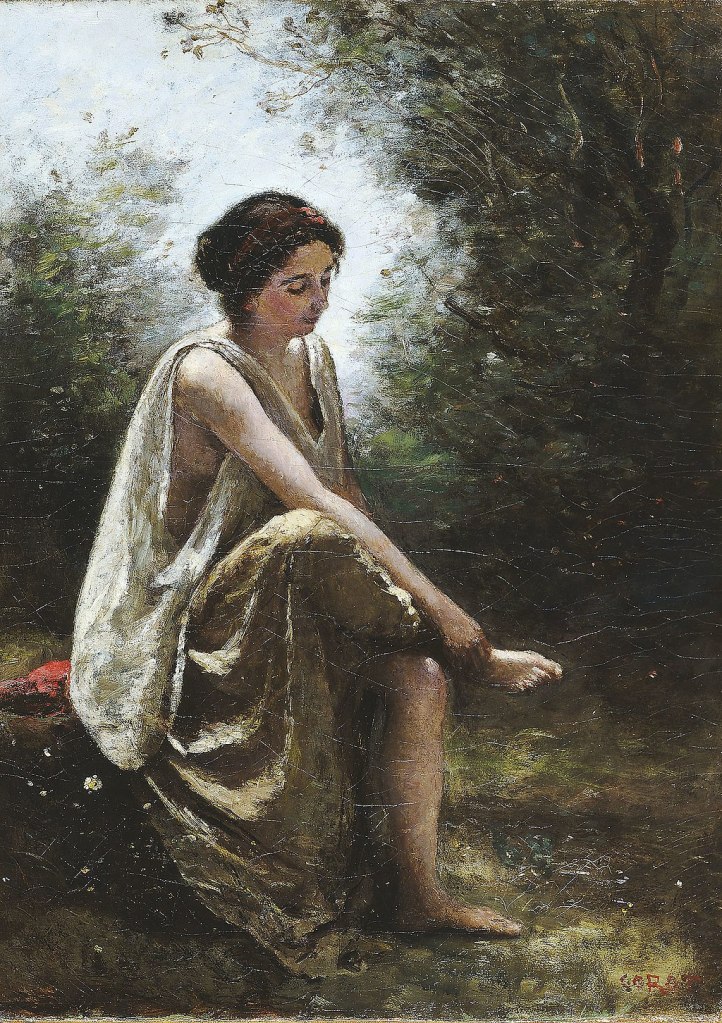
By Jean-Baptiste Camille Corot – https://www.artic.edu/artworks/878, Public Domain
I hope this clip holds, over the years or that Lucia is plucked from the halls of German houses and put in the hallowed halls her voice should echo: https://www.youtube.com/watch?v=hFmudg64ZSM
 The World of Before You